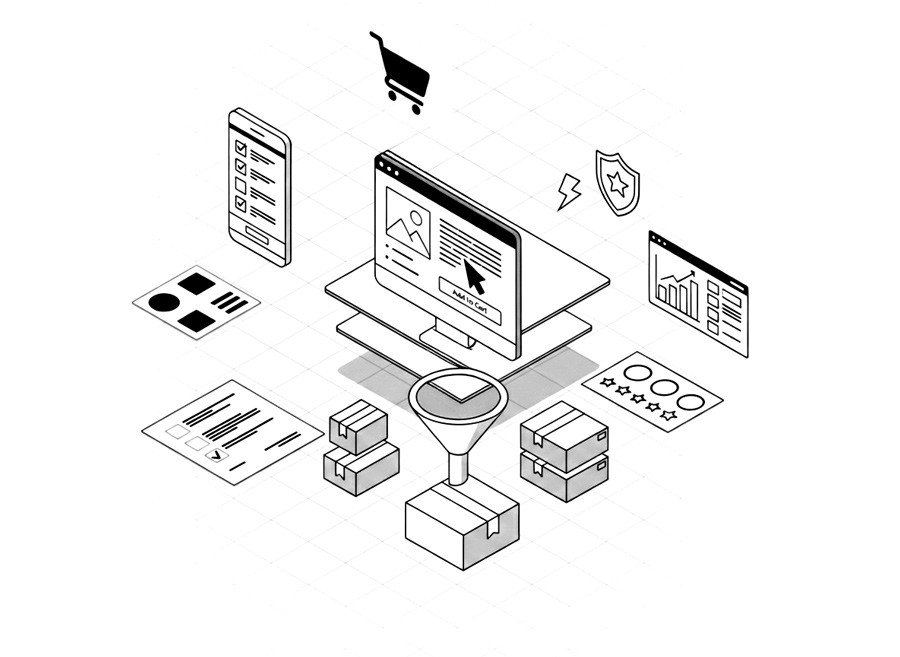
AI tools in ecommerce solve execution problems, not strategy problems. If your product page buries the value proposition or your positioning is unclear, no chatbot or dynamic pricing engine will fix your conversion rate. This matters because most founders add AI before they've solved the manual, high-leverage problems that actually drive sales.
The pattern shows up repeatedly: you're spending $3K/month on ads, traffic is steady, but conversions sit at 1.2%. You add a recommendation engine or personalization tool, hoping it will close the gap. It doesn't. The real bottleneck was messaging or page structure, and you just automated around it.
AI Becomes Useful After You've Solved Clarity
There's a threshold where AI shifts from premature to practical. It happens when manual execution becomes the bottleneck, not when you're still figuring out what converts.
If you're doing $10K–$100K/month and conversions are stuck, your first problem is almost always positioning, messaging, or page structure. AI tools cost money and attention. A chatbot runs $50–$300/month. Dynamic pricing requires testing and monitoring. Personalization engines need traffic volume to learn patterns. If traffic bounces because your value proposition is buried in paragraph three, you're optimizing the wrong layer.
The implication: get your product page to convert at 3%+ before you automate recommendations. Nail your support workflow before you hand it to a bot. AI should enter your stack after you've fixed the problems you can see in session recordings and drop-off data.
The Four Areas Where AI Actually Removes Friction
AI applications in ecommerce cluster around personalization, pricing, inventory management, and customer service. Each solves a different type of friction, and the tradeoffs matter.
Personalization addresses relevance at scale. If you have enough traffic and product variety, it helps visitors find what they want faster. Dynamic pricing optimizes margin against demand elasticity, but only if your baseline pricing already makes sense for your market. Inventory tools reduce stockouts and overstock costs when you're managing complexity across SKUs or channels. Customer service automation handles repetitive support volume.
None of these fix a broken funnel. If your pricing is wrong for your market, making it dynamic just automates the mistake faster. If your product page doesn't communicate why someone should buy, personalizing the homepage won't move the needle.
Which Tools Matter at Your Stage
Most DTC founders should only care about two or three of the seven common AI applications. Customer service automation makes sense if support volume is eating 5–10 hours of your week answering the same 15 questions. Personalization makes sense if you have the traffic and product catalog to justify it. Pricing and inventory tools make sense if you're managing complexity you can't handle manually.
The rest—recommendation engines, predictive analytics, content generation—are either premature or adjacent to your core conversion problem. They might matter when you're doing $500K/month. They don't matter now.
Before you add AI to your stack, audit where your funnel actually breaks. Track drop-off points. Run session recordings. If people leave because they don't understand the product, don't trust the offer, or don't see the value, no algorithm will help. Fix the messaging. Restructure the page. Test the offer.
Once conversion is above 2.5% on cold traffic, AI becomes a force multiplier. Use it to handle repetitive work that's already proven. Use it to scale what's already converting. Don't use it to guess your way out of a positioning problem.