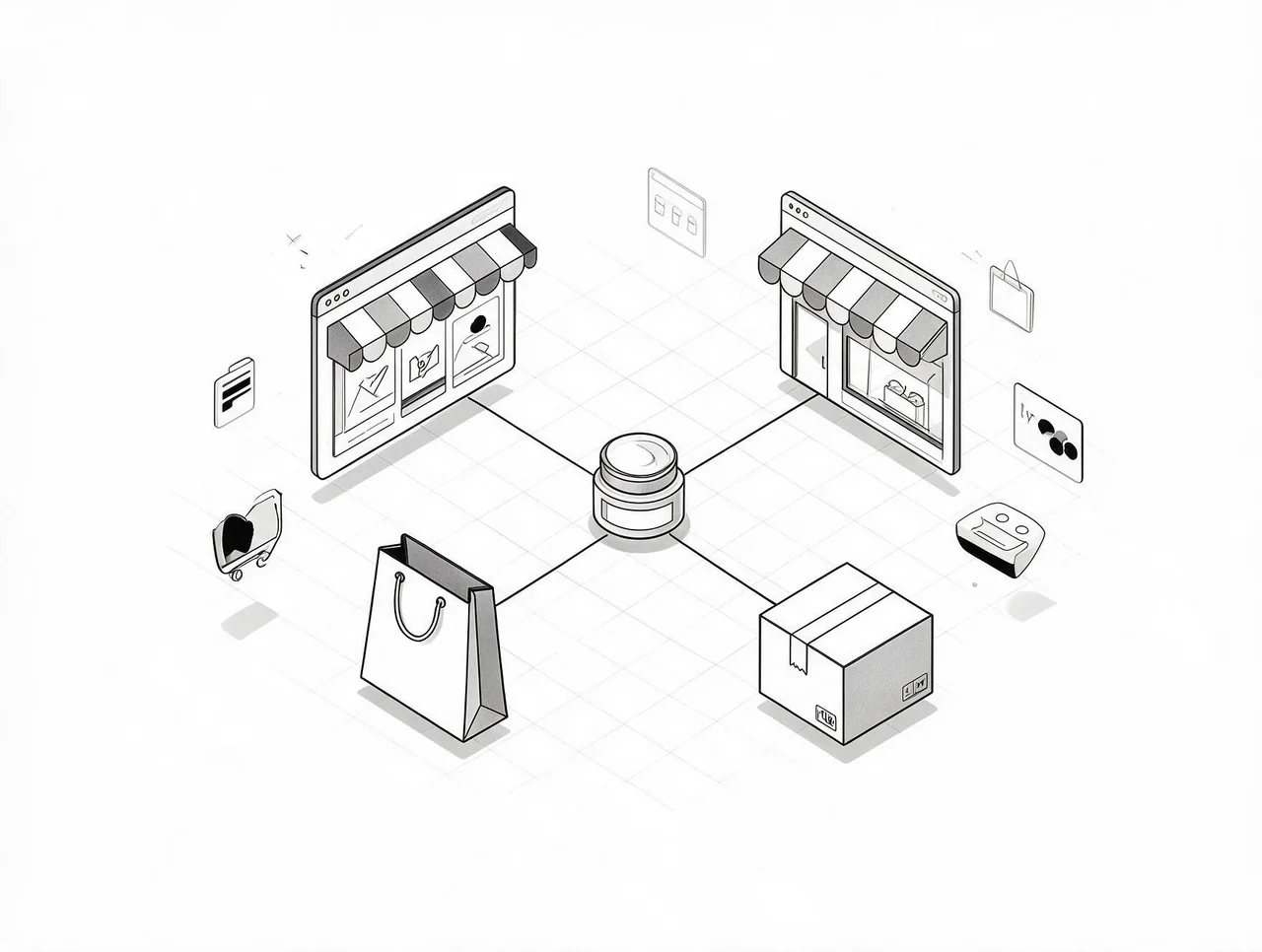
OSEA Malibu spent 30 years building a skincare brand, then scaled to nine figures under Melissa Palmer by distributing across D2C, Amazon, TikTok Shop, and 1,500+ Ulta stores. The brand didn't prioritize one channel. It built equal revenue engines across all four. Most Shopify brands doing $10K–$100K monthly treat their store as the primary funnel and everything else as secondary. That hierarchy is why they stay stuck.
Single-Channel Brands Pay Acquisition Costs to Solve a Distribution Problem
When you concentrate growth efforts on Shopify, you optimize for a shrinking slice of customer discovery behavior. OSEA's presence across four platforms means they intercept customers at multiple decision points. A buyer discovers them on TikTok Shop, researches on Amazon, converts in Ulta, then reorders on D2C. Single-channel brands miss three of those four touchpoints.
This creates a data problem. OSEA tests creative on TikTok Shop, learns pricing tolerance on Amazon, observes in-store behavior at Ulta. Shopify-only brands can't access those signals. Your conversion rate isn't just a function of your landing page. It's constrained by how much of your addressable market ever reaches that page. If you're spending $50 to acquire a customer on paid social and driving them to Shopify, you're paying to fight platform algorithms instead of letting platform traffic work for you.
Each Channel Has Different Economics and Different Jobs
Amazon customers expect fast shipping and sort by Prime eligibility. TikTok Shop buyers respond to social proof and impulse triggers. Ulta shoppers want to test products physically. Your Shopify store attracts people who already know your brand or trust standalone sites. OSEA matched product-market fit to platform-market fit across all four.
A brand doing $50K monthly on Shopify might assume they need better email flows. But if their product has strong visual appeal, TikTok Shop's algorithm could deliver customers at a fraction of paid social costs. If they sell consumables with predictable reorder cycles, Amazon's Subscribe & Save creates automatic retention that email campaigns have to work harder to achieve. The tradeoff: each channel demands different operational capabilities. Amazon requires inventory forecasting. TikTok Shop needs video content production. Retail partnerships involve wholesale margins and sell-through pressures. But these aren't just costs. A competitor can copy your Shopify store in a week. They can't replicate 1,500 retail doors or an Amazon catalog with years of reviews.
Multi-Channel Distribution Changes the Math on Customer Lifetime Value
OSEA's customers don't stay in one channel. A customer acquired through TikTok Shop at low cost might reorder on Amazon for convenience, buy gift sets in Ulta, then subscribe on D2C for exclusive products. Each channel serves a different job in the customer journey. This changes unit economics. If your Shopify conversion rate is 2% and you're spending $50 per customer, you're trapped in a margin squeeze. But if you acquire customers on TikTok Shop at $15 through organic-style content, convert browsers on Amazon where they're already shopping, and use Shopify for high-margin bundles, the blended economics improve.
OSEA's Ulta presence likely operates at lower margins but builds brand credibility that increases D2C conversion rates. Their Amazon catalog probably prioritizes volume on hero products while Shopify focuses on full-size sets with higher margins. This portfolio approach means they're not dependent on any single channel's economics. Your current revenue ceiling might be structural, not tactical.
Where to Start If You're Stuck at $10K–$100K Monthly
OSEA's 30-year legacy gave them brand equity, but their nine-figure scale came from distribution strategy. The lesson isn't to launch on four platforms immediately. It's to recognize that your Shopify store is one node in a multi-platform system, not the destination. Identify where your customers already have buying intent. If you're in beauty or wellness, Amazon and TikTok Shop are high-intent environments where customers actively browse. If your product is giftable or impulse-friendly, TikTok Shop's discovery algorithm can drive volume without paid spend.
Stop spending 80% of your effort optimizing a single Shopify funnel. Reallocating 30% of that effort to a second channel could unlock more growth than another round of landing page tests. The constraint isn't your conversion rate. It's how many potential customers ever enter your funnel in the first place.