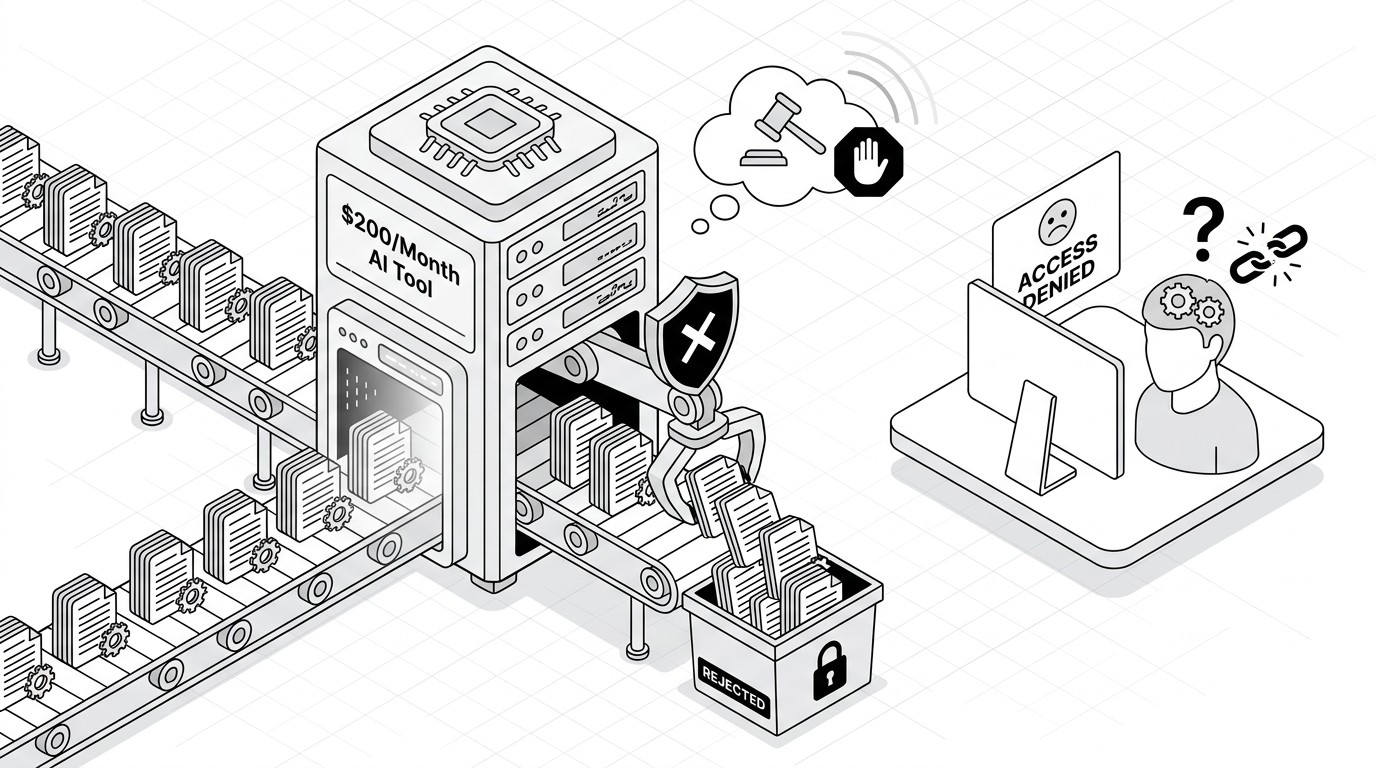
A developer paying $200 monthly for Claude's max subscription keeps hitting the same wall: "Own bug file, not malware." The AI refuses to parse HTML containing JavaScript. It blocks cookie automation for a Chrome extension. It questions whether the work constitutes a security bypass. The developer works in scraper tech. Their clients are the companies being scraped. Claude has both facts and still says no.
You're Not Buying Capability, You're Renting Judgment
The implicit contract with paid software is simple: money for functionality. You're not asking the tool to approve your work. You're asking it to execute. AI coding assistants break this model. They ship with embedded values that can veto your use case, and there's no way to disable them.
This isn't content moderation or abuse prevention. The developer isn't writing ransomware or building credential stealers. They're doing work that exists in a legal gray zone, data extraction, often with permission from the entities being scraped. The AI can't distinguish between legitimate edge-case work and malicious activity, so it defaults to refusal. The result is workflow interruption at the tool level, not a terms-of-service warning or human review. An automated judgment stops the work entirely.
The developer describes feeling controlled rather than supported. That's the actual tradeoff: safety theater in exchange for reduced utility. For users doing conventional work, the guardrails are invisible. For anyone in security research, competitive intelligence, or reverse engineering, the tool becomes unreliable. The work itself hasn't changed, scraping existed before AI assistants. The difference is that now your $200/month tool can refuse to help, and you have no recourse except switching tools or working around the blocks manually.
The Generational Assumption Shift
The developer is over 40. They grew up reading about Kevin Mitnick and belonged to a local computer club where hacking systems, without malicious intent, was normal exploration. At 14, outsmarting systems was education. That era assumed curiosity was neutral until proven otherwise.
AI tools assume the opposite. Ambiguous activity is risky until proven safe. The developer now questions whether they're "the bad guy" simply for doing work that doesn't fit approved categories. This isn't paranoia. It's a rational response to tools that treat edge cases as threats by default.
This creates a split. Younger developers who grow up with these guardrails may internalize them as normal. Older developers, or anyone whose work predates AI's ethical categories, will experience them as new constraints. The question isn't whether guardrails are justified in some cases. It's whether paying customers should have their work judged by the tools they rent, especially when that work is legal and the tool has full context.
The Market Isn't Paying Attention Yet
The Hacker News post about this issue has 16 points and 10 comments. A post about category theory has 109 points and 32 comments. The users affected by this friction are doing work that doesn't fit templates. They're also the ones most likely to churn when the tool becomes a bottleneck instead of an accelerant.
If you're building or buying tools with embedded decision-making, this is the warning sign: the tool's assumptions about good and bad use cases will eventually conflict with someone's legitimate work. When that happens, the user doesn't get more careful. They get a different tool.
The tradeoff is binary. Build tools that prevent misuse, or build tools that trust paying users to make their own ethical calls. You can't do both. Right now, AI tools are choosing the first option and hoping the second group is small enough to ignore.