
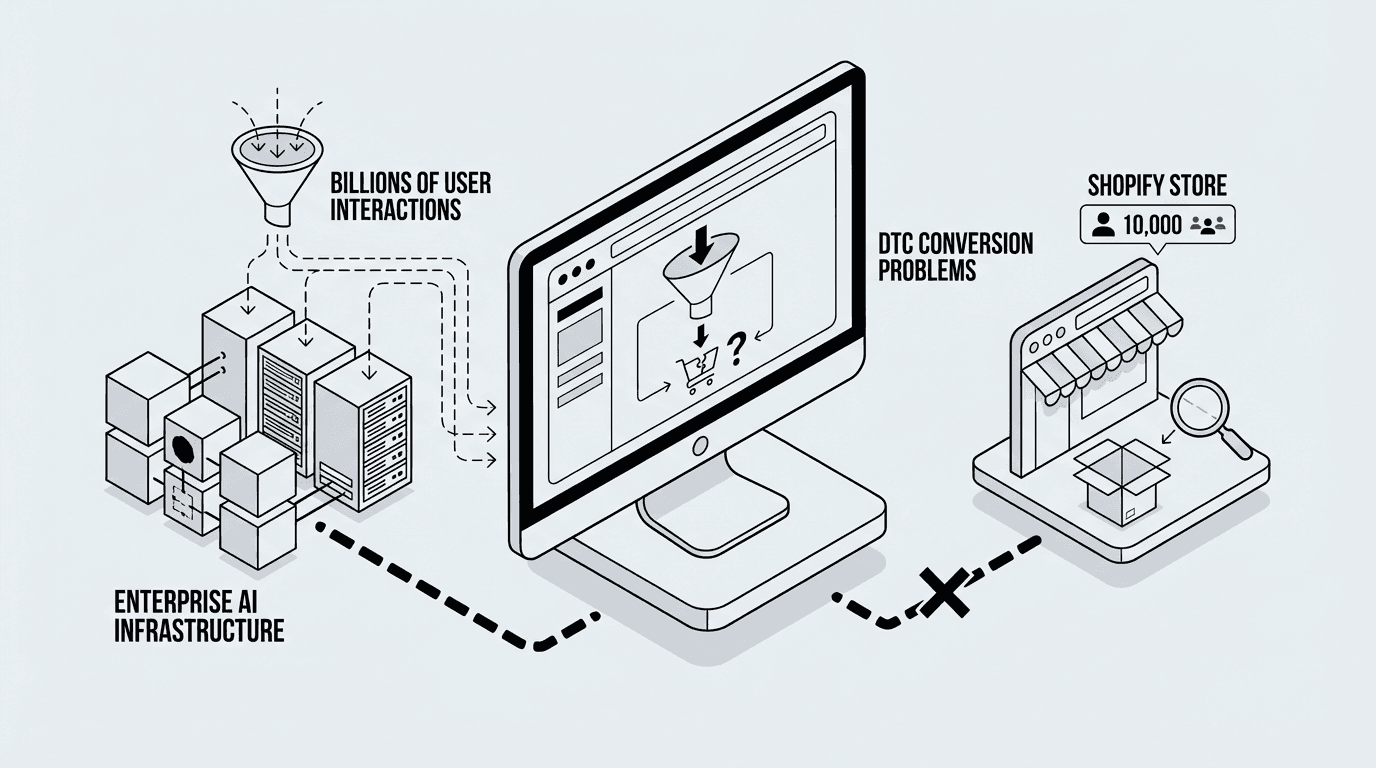
Meta built an internal tool that converts employee mouse movements and button clicks into training data for AI models. The system works because Meta has billions of users generating trillions of interactions. For a Shopify store with 10,000 monthly visitors, this approach collapses immediately. You don't have the volume to train anything meaningful, and more importantly, the problems killing your conversion rate aren't solved by custom AI models.
The gap between enterprise AI infrastructure and DTC store operations isn't about sophistication. It's about what the constraint actually is. Meta optimizes for scale and generalization across massive datasets. A DTC store doing $50K/month optimizes for specificity and speed on a narrow conversion path. Meta can invest years building infrastructure that improves performance by 2% across a billion users. You need to identify why 60% of add-to-cart users abandon before checkout, and you need an answer by Friday.
The Volume Problem Makes Training Irrelevant
Training AI models requires patterns across massive datasets. Below a certain threshold, you're not training a model, you're overfitting to noise. A store with 10,000 monthly visitors and a 1.2% conversion rate generates 120 purchases. That's not enough signal to train anything that generalizes. Even if you captured every mouse movement and click, you'd be building infrastructure to solve a data problem you don't have.
The actual constraint is clarity, not computation. Most conversion problems are visible in under an hour of session recordings. The headline doesn't match the ad. Product images don't show scale. Benefits are listed as features. The CTA is buried. Price appears before value is established. These aren't machine learning problems. Watching twenty sessions of people landing on your product page and leaving without scrolling will surface more actionable insight than any model trained on your current traffic volume.
Automation Compounds Your Base Rate
When DTC founders talk about AI automation, they usually mean email sequences triggered by behavior, chatbots handling support tickets, or dynamic product recommendations. These tools work, but they're downstream solutions. If your site converts at 1.2% and your average order value is $67, automating email flows might lift revenue by 8-15%. That's real money, but it doesn't fix the structural problem: most paid traffic leaves without engaging because positioning is unclear or the offer doesn't match the ad.
Anthropic is investigating claims that an unauthorized group accessed Mythos, its internal cyber tool, though the company maintains no evidence suggests their systems were compromised. Large AI companies worry about unauthorized access because internal tools represent significant competitive advantage. For a DTC brand, the risk profile inverts. Your biggest threat isn't someone stealing your automation setup. It's investing time and money into automation before your core conversion path works. Automating a broken process scales the break.
Resource Allocation Under Constraint
Redwood Materials laid off 10% of its workforce while restructuring teams. This is a standard move: cut costs in one area to fund growth in another. The company is making a bet on where future revenue comes from. The parallel for DTC isn't about layoffs. It's about resource allocation when you're constrained. If you're spending $8K/month on ads and $2K/month on automation tools, but your site converts at 1.1%, you're structured wrong. Stop funding distribution before you fix conversion.
This creates a sequencing problem most founders get backward. Automation tools promise efficiency, and efficiency sounds like the answer when you're stretched thin. But if your product page doesn't clearly communicate who the product is for and why they should care, an AI chatbot won't fix it. It'll just answer questions from people who were never going to buy. Email automation and customer support bots become useful after you fix core conversion issues. Once your main path converts at 2.5-3%, automation compounds that base rate. Before that threshold, you're automating waste.
What Translates From Meta's Approach
The useful takeaway from Meta's data collection isn't the AI training. It's the focus on what users actually do, not what they say they'll do. For a DTC store, this translates to session recordings, heatmaps, and checkout analytics. You don't need machine learning. You need to watch real sessions and identify where the conversion path breaks.
Every dollar and hour spent on automation is a dollar and hour not spent on conversion fundamentals. This isn't an argument against automation. It's an argument for sequence. Meta can build infrastructure for years before seeing returns because they're capitalized for it. Redwood can restructure because they're playing a long-term industrial game. You're running a DTC store on paid ads with 30-60 days of cash runway. Your constraints are different, so your strategy has to be different. The question isn't whether AI automation works for ecommerce. The question is whether it works for your store, at your scale, with your current conversion rate. Most of the time, the answer is no, not yet.