
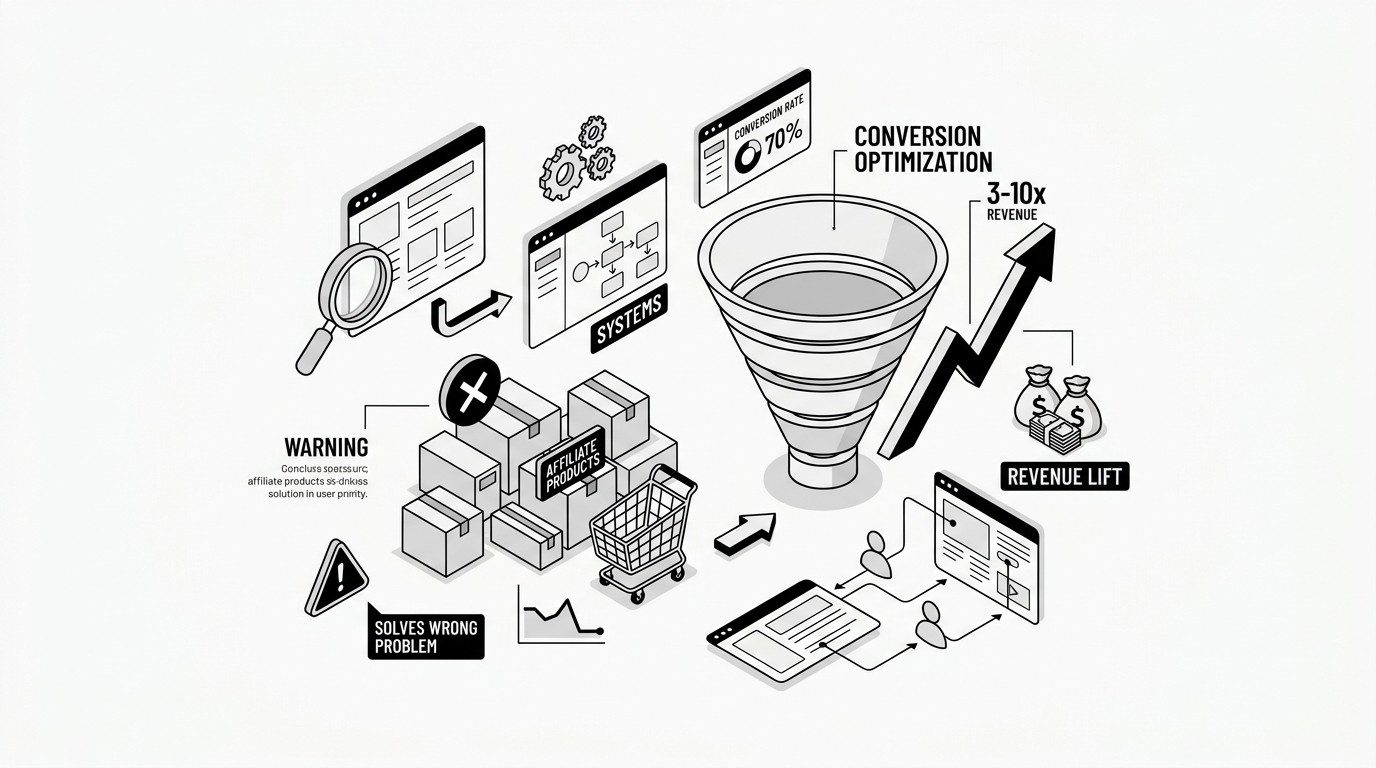
Christina Semak published a list of seven affiliate products with strong 2026 demand on June 4th. The premise: add affiliate inventory to increase revenue without holding stock. For DTC brands doing $10K–$100K monthly, this solves the wrong problem. The bottleneck isn't product selection, it's how many visitors complete purchase.
The Real Constraint Is Conversion, Not Catalog Size
When a Shopify store plateaus between $10K and $100K per month, founders assume they need more products. More SKUs mean more reasons to buy, more traffic capture, more revenue paths. This misdiagnoses the actual constraint.
Stores in this revenue band typically have sufficient traffic and product-market fit to hit six figures. What they lack is conversion efficiency. The gap isn't product breadth. It's how clearly value propositions communicate and how much friction exists in the buying process.
Adding affiliate products creates three new problems. First, it fragments your positioning. Every additional product category requires explanation and trust-building. Your homepage now serves multiple audiences with different intent. Second, it splits your paid ad budget across disparate product lines with different customer profiles. Third, it delays the work that actually moves metrics: fixing checkout flows, clarifying product benefits, improving page load speed.
When Affiliate Inventory Actually Works
The model succeeds when you have excess traffic with unmet adjacent needs. Visitors who trust your brand enough to consider related purchases but won't convert on your core product. This requires high traffic volume (typically 50K+ monthly visitors) and established brand authority in a specific niche.
Below 50K monthly visitors, the math breaks down. Affiliate conversion rates typically run 1-3%. If you're sending 10K visitors monthly to affiliate products, you're generating 100-300 clicks. At 5-10% affiliate conversion rates, that's 5-30 sales. Even at $50 average order value and 10% commission, you've added $25-$150 monthly revenue.
Meanwhile, a 0.5% improvement to your core product conversion rate, achievable through basic CRO work, would add $500-$5,000 monthly at your current traffic levels. The opportunity cost is severe.
The Conversion-First Alternative
If revenue has stalled, run this diagnostic first. Calculate your current conversion rate, average order value, and customer acquisition cost. Then model what happens if you improve each by 20% versus adding affiliate revenue. Most brands discover that conversion rate improvements deliver 3-10x more revenue than affiliate additions.
Higher conversion rates make paid ads more profitable, which allows higher bids, which captures more traffic, which generates more data for optimization. This creates a growth flywheel. Affiliate products create a revenue trickle.
Focus your next 90 days on three conversion levers. First, audit your product pages for clarity: Can a visitor understand your value proposition in five seconds? Do images show the product in use? Are benefits concrete and specific? Second, map your checkout flow for friction points. How many form fields? Are shipping costs visible early? Does the page load in under two seconds? Third, review your ad-to-landing-page message match. Does the landing page deliver what the ad promised?
These improvements don't require new inventory, partner relationships, or program management. They require focused attention on the funnel you already have. Once you've optimized core conversion and scaled past $200K monthly, when you have traffic surplus and team capacity, affiliate products become viable. Before that point, they're a distraction disguised as opportunity.