Most Shopify stores treat email like a broadcast channel. They set up a welcome series, turn on cart abandonment, and send a weekly newsletter. Open rates look fine. Revenue doesn't move. The problem isn't execution, it's that no one defined what each email is supposed to change. Without objectives tied to specific conversion problems, you're just adding volume to a broken funnel.
Shopify outlines seven email marketing objectives that should inform your strategy. These aren't campaign ideas. They're a diagnostic framework. If you can't map every email you send to at least one objective, you're guessing. And guessing doesn't scale past $50K/month.
Objectives Define What Changes, Not What You Send
The mistake is treating objectives like campaign themes. "Let's do a welcome series." "Let's send a cart abandonment email." These are tactics. An objective defines what shifts in your customer's behavior or perception after they receive the email.
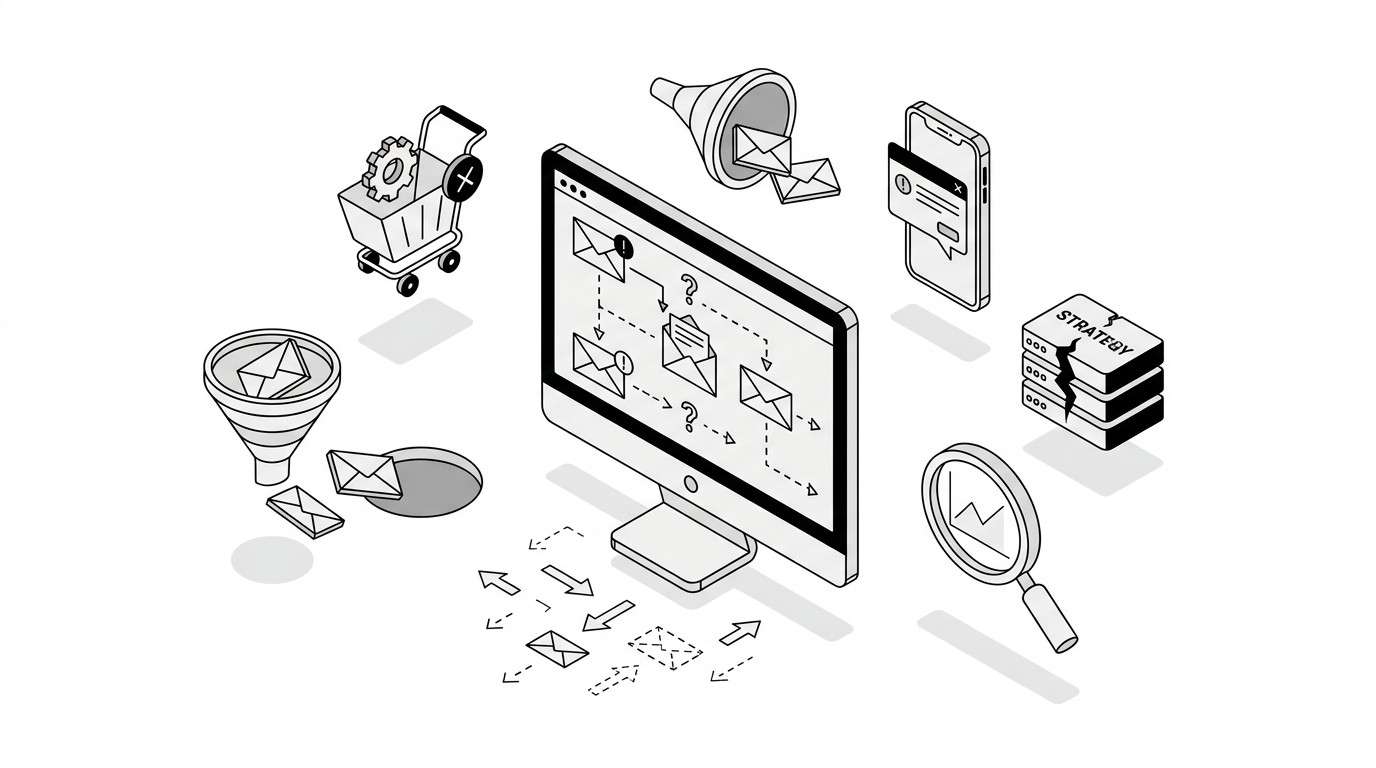
Do you need to move someone from awareness to consideration? Recover a lost sale? Increase purchase frequency among existing buyers? Each objective ties to a specific conversion problem. Most DTC stores between $10K and $100K/month have multiple conversion problems at once. You're losing people at the product page. You're losing them at checkout. You're losing them after the first purchase. If your email strategy doesn't explicitly target each leak, you're just sending more emails into a system that's already failing.
You Can't Execute All Seven Objectives at Once
Small teams stall here. They set up flows for every objective, then watch open rates drop and unsubscribes climb. The tradeoff is simple: breadth dilutes focus. If you're sending emails for seven different objectives, you're splitting your creative energy and your testing budget. Worse, you're training your list to ignore you because there's no consistent reason to open.
Pick two objectives that map directly to your biggest revenue leak. If you're converting traffic but not retaining customers, focus on post-purchase engagement and repeat purchase triggers. If you're getting traffic but not conversions, focus on nurturing cold leads and recovering abandoned sessions. You can add objectives later, but only after you've proven the first two work. This isn't about doing less, it's about learning faster.
Why Copying Successful Brands Doesn't Work
Shopify mentions you can achieve these objectives with tips from successful businesses. That's true, but it's also where most founders go wrong. They copy what works for a brand doing $5M/year and expect it to work at $30K/month.
Successful businesses have different constraints. They have larger lists, more segmentation data, higher brand recognition, and often a product line that supports cross-sell. If you're running one to five products, you don't have the same leverage. Copying their six-email welcome series or their VIP loyalty program is like copying their ad budget. It doesn't translate.
What does translate: the logic behind their objectives. If a successful brand sends a post-purchase email three days after delivery, the objective isn't "send an email on day three." It's "reduce the window where a customer might forget why they bought or feel buyer's remorse." You can achieve that objective with a different cadence, different copy, or a different offer depending on your product and margin. Objectives are transferable. Tactics are not.
How to Audit Your Current Email Strategy
Most founders don't know if their emails are working because they're measuring the wrong things. Open rates and click rates are activity metrics. They don't tell you if the objective was achieved.
List every automated email and broadcast you send. For each one, write down the objective in one sentence. If you can't, that email is probably waste. Then map each objective to a conversion metric: revenue per recipient, repeat purchase rate, cart recovery rate, average order value, time to second purchase.
Now compare performance. If your cart abandonment emails have a 40% open rate but only recover 2% of carts, the objective isn't being met. Either the offer is weak, the timing is off, or the copy isn't addressing the real friction. This is where you focus your testing budget. If you find emails that don't map to any objective or don't move a conversion metric, kill them. Every email that doesn't serve an objective is training your subscribers to ignore the ones that do.
What This Means for Your Store Right Now
If you're running paid ads and struggling with conversion, email is not a growth channel. It's a retention and recovery system. Your job is to stop the leaks before you scale the top of the funnel.
Pick two objectives that directly address your biggest drop-off points. Build one automated flow for each. Measure the conversion metric, not the vanity metric. Test one variable at a time: subject line, send timing, offer structure, or friction removal. Don't add more emails until these two flows are consistently moving the needle.
Once you've proven the system works, layer in the next objective. But only after you've extracted everything you can from the first two. This is how you build an email strategy that actually supports your ad spend instead of just adding noise to your customers' inboxes.