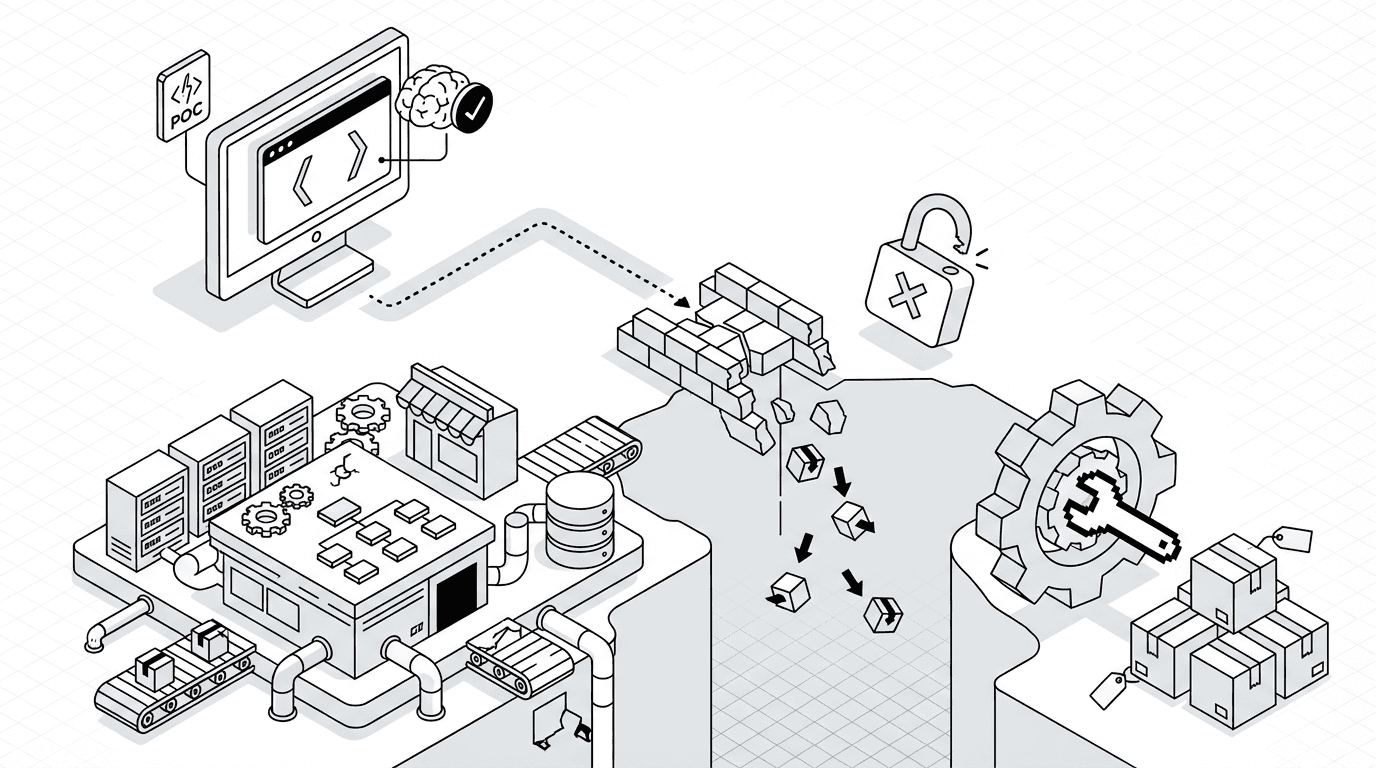
The proof of concept succeeds. The AI generates product descriptions that sound natural, or it predicts inventory needs with reasonable accuracy. Then the project stalls. This happens so consistently that the pattern itself is the problem worth examining.
POCs fail to predict implementation outcomes because they test the wrong variable. They answer whether the technology works in isolation. They don't answer whether your business can absorb it without breaking other things.
POCs Test the Tool, Not Your Infrastructure
A proof of concept minimizes variables on purpose. Clean data, simplified scenarios, dedicated attention. The AI performs well because the test environment removes the friction that exists in your actual operation.
Your store doesn't have clean data. Product catalogs have inconsistent naming. Attributes are missing. Variants are poorly organized. The AI needs structure to function, which means implementation starts with cleaning up years of accumulated mess. You're not adding a tool anymore. You're fixing foundational problems that were easy to ignore until now.
Integration compounds this. Your store runs on Shopify, but email runs through Klaviyo, reviews through a third-party app, inventory tracking through Google Sheets. The AI needs to connect to multiple systems that weren't built to talk to each other. Each connection adds maintenance burden and potential failure points. The POC didn't test any of this because it ran in isolation.
Implementation Costs Surface After Commitment
When you move from POC to implementation, the cost structure changes completely. You're no longer evaluating the tool. You're evaluating whether your entire operational setup can support it.
Someone on your team has to own this. They troubleshoot when it breaks. They review outputs that need human judgment. They manage updates and integration changes. If you're running lean, that time comes from other priorities. The email sequence you were planning to build gets delayed. The product page optimization you wanted to test gets pushed back.
For a DTC founder doing $10K–$100K monthly, this tradeoff matters. The AI might deliver value, but if implementation takes three months and requires ongoing attention, the opportunity cost might exceed the benefit. The POC made the tool look easy because it didn't account for what you'd have to stop doing to make room for it.
The Stall Is a Resource Allocation Signal
Projects stall after POC when founders realize the next step requires more time or focus than they're willing to commit. Not because the tool lacks value, but because extracting that value costs more than expected.
This reveals something useful: most businesses aren't structured to absorb new tools without operational changes. The POC proves the technology works. It doesn't prove your business is ready to reorganize around it. Those are separate problems, and solving the first doesn't address the second.
Before committing to an AI tool, map the full implementation path. What data does it need, and do you have it in usable form? What systems does it need to connect to? Who owns it, and what do they stop doing to make time? If these answers are unclear, the project will stall regardless of how well the POC performed.
The pattern repeats because the validation phase tests the wrong thing. It tests whether the AI can perform a task. It should test whether your business can change enough to use it.