
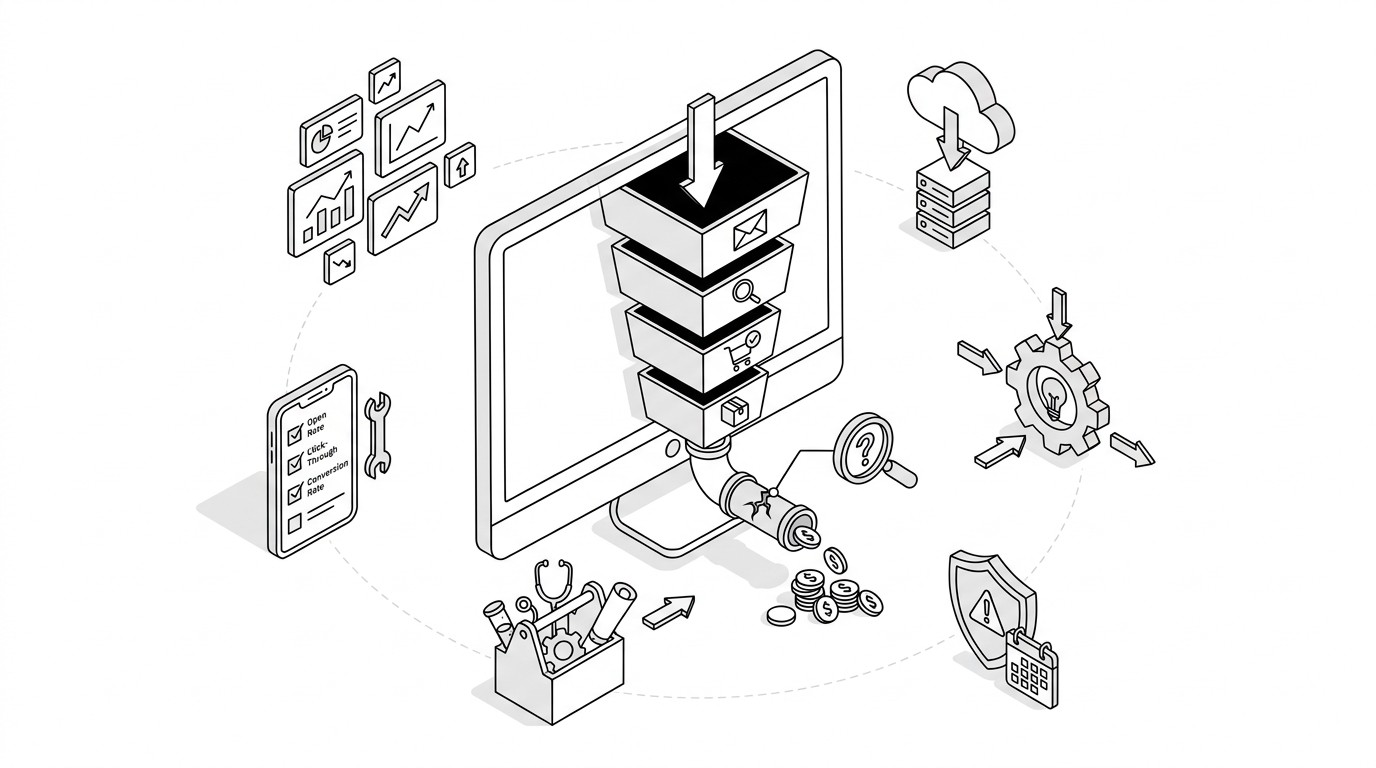
The seven email marketing objectives exist to diagnose where your conversion system is failing. List growth, engagement, conversion, retention, referral, segmentation, and automation aren't campaign targets you chase in parallel. They're indicators that map to specific breakage points in your funnel. If you're spending on ads but not capturing emails, your site isn't surfacing the right incentive at the right moment. If emails get opened but don't convert, the gap is between what you promised in the message and what the product page delivers. If customers buy once and disappear, you haven't built a reason for them to return.
Most stores track these objectives the way they track open rates: as performance metrics that should trend up and to the right. That framing inverts the purpose. These objectives tell you where to look when revenue stalls, not what number to hit. Missing two out of seven doesn't mean you're 71% effective. It means those two gaps are probably where your funnel is hemorrhaging money.
You Can't Optimize All Seven Simultaneously
Trying to improve list growth, engagement, conversion, retention, referral, segmentation, and automation at the same time guarantees you'll do all of them poorly. The constraint isn't knowledge or tooling. It's attention and resources. A small team running paid acquisition can't also build a referral program, segment by behavior, and automate post-purchase sequences without spreading so thin that none of it works.
The correct approach is to sequence based on where your funnel is weakest. If traffic is high but email capture is low, list growth is the bottleneck. If capture is strong but first-purchase conversion is weak, your messaging or offer structure is broken. If conversion happens once but repeat rate is anemic, retention is the constraint. Copying a competitor's referral program when your real problem is first-purchase conversion wastes time solving the wrong constraint.
This is why tactics borrowed from other brands often fail. A store that scaled through referrals had already solved retention. A store that scaled through segmentation had already solved engagement. The tactic worked because it addressed their specific constraint. Applying it to a different constraint produces activity without outcomes.
Activity Metrics Hide Whether Emails Reduce Friction
Open rates and click rates measure engagement, not progress toward a purchase decision. High engagement on a welcome series means nothing if the landing page contradicts the email's promise. A post-purchase sequence with strong open rates but no repeat purchases means the emails aren't giving buyers a reason to care about the next step.
The real question is whether each email removes friction or adds noise. If your abandoned cart email offers a discount but the product page doesn't address the objection that caused the abandonment, the email generates a click but not a conversion. If your win-back campaign highlights new products but the customer's original purchase had a quality issue you never acknowledged, the email feels tone-deaf.
Most Shopify stores build flows that look complete in the dashboard but don't map to the actual decision-making process. They send a welcome series because that's what you're supposed to do, not because they've identified what information a new subscriber needs to move from consideration to purchase. The objective isn't more emails. It's fewer obstacles between intent and transaction.
Audit Against Objectives to Find Your Constraint
If you're doing $10K–$100K/month and email isn't contributing proportionally to revenue, start by identifying which of the seven objectives you're ignoring. Not underperforming, ignoring. If you have no segmentation, you're treating a first-time visitor the same as a repeat buyer. If you have no automation, you're manually deciding when to follow up instead of triggering based on behavior. If you have no referral mechanism, you're assuming customers will recommend you without being asked.
Pick the objective that maps to your biggest revenue leak and fix that before moving to the next. If ad spend is high but email capture is low, list growth is the constraint. If capture is strong but conversion is weak, your messaging or offer structure needs work. If conversion happens once but repeat rate is low, retention is the gap. Treating email as a separate channel instead of part of the same conversion system as your product pages, ad creative, and checkout flow is why optimization in one area doesn't translate to revenue growth.
The seven objectives tell you where to focus, not what to do. The tactics depend on which friction point you're solving for. That's the difference between sending emails and running a system that converts traffic into repeat buyers.