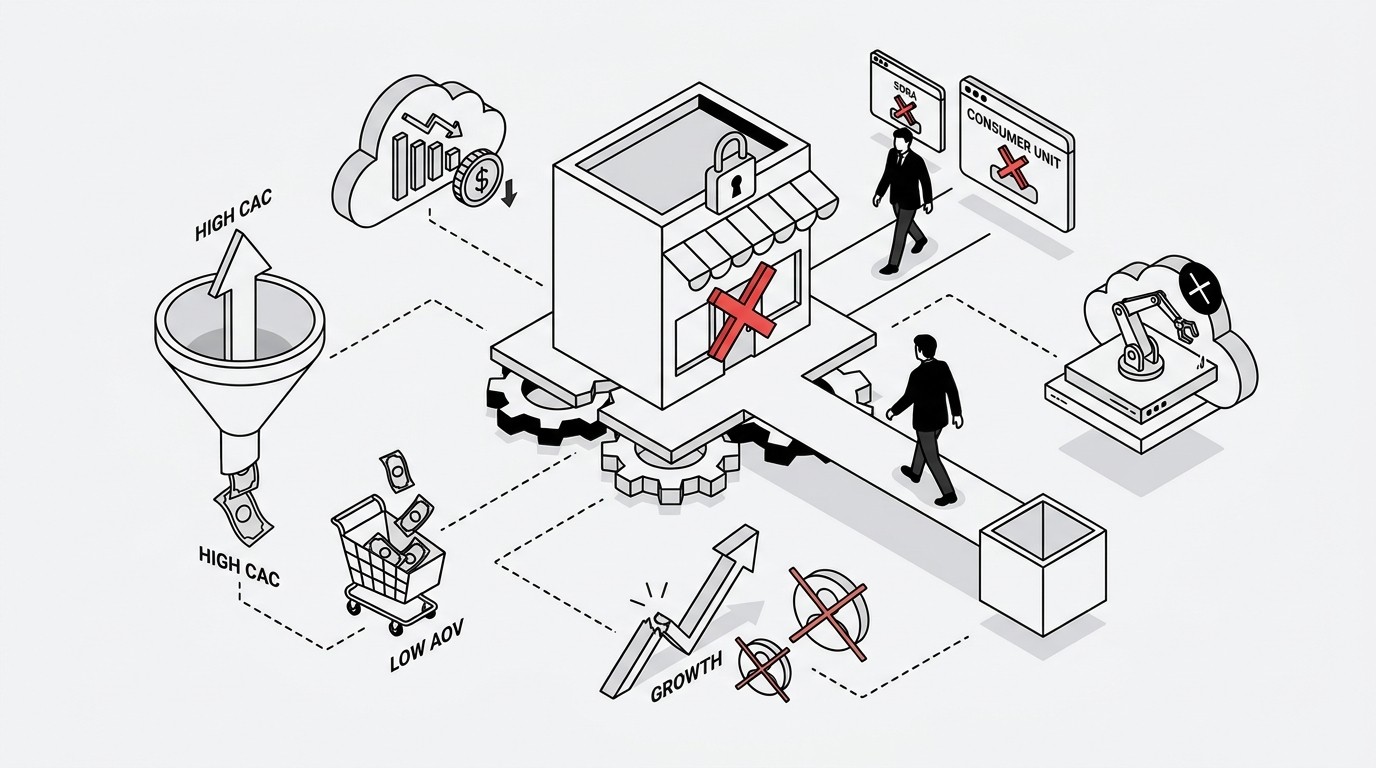
OpenAI shut down Sora and folded its science team. Kevin Weil and Bill Peebles left. These aren't separate events. They're symptoms of the same problem: consumer products cost too much to acquire users and generate too little revenue per customer. OpenAI had the capital to keep trying. They quit anyway.
If you're running a DTC store with $40 CAC and $65 AOV, you're facing the same math. The difference is OpenAI can afford to pivot. You might not get that chance.
The Unit Economics Problem Isn't Fixable With Better Ads
Sora worked as a product. It generated video. Users liked it. OpenAI killed it because the business model underneath couldn't support itself. Free users stayed free. Paid conversions stayed low. Acquisition costs stayed high. The gap between what it cost to bring someone in and what they paid never closed.
Your store has the same structure. You spend $40 on Facebook ads to acquire a customer who buys once for $65. Gross margin is maybe $30. You're underwater before they even consider a second purchase. You tell yourself better landing pages will fix it, or tighter email sequences, or a new offer. But the problem isn't execution. It's that consumer acquisition costs have risen faster than consumer willingness to pay.
OpenAI's decision signals they stopped believing optimization would save them. They looked at the CAC-to-LTV curve and decided the slope would never improve enough to matter. If a company with their resources won't keep trying, what makes you think your A/B tests will crack it?
Leadership Exits Reveal Strategy Shifts Before They're Announced
Weil and Peebles didn't leave because of a bad quarter. They left because the company's direction changed under them. If they were hired to build consumer-facing AI products and OpenAI is now prioritizing enterprise contracts, their roles lost relevance. Talented people don't stay in jobs where the work they signed up for no longer exists.
Watch for this in your own business. If your best hires start disengaging, the issue usually isn't them. It's that your business model can't support the strategy you hired them to execute. You brought on a growth marketer to scale paid acquisition, but your unit economics can't handle scale. You hired a retention specialist, but your product doesn't generate enough repeat purchases to justify the role. The mismatch between what you're trying to build and what the economics allow creates friction that good people eventually walk away from.
Consumer Volume Versus Enterprise Margin Is a Forced Choice
OpenAI is choosing margin. They're walking away from millions of potential Sora users to focus on fewer customers who pay more and stay longer. Enterprise contracts close once and renew annually. Consumer products require continuous ad spend just to maintain revenue.
You face the same tradeoff, even if you're not selling to businesses. A $60 impulse purchase to cold traffic is a consumer play. A $600 annual subscription or a $300 product sold to a warm audience is closer to enterprise economics. The latter costs less to acquire relative to what it generates. It also means fewer customers and slower growth.
Most DTC founders resist this tradeoff because consumer volume feels like progress. You'd rather have 1,000 customers at $65 each than 100 customers at $600 each, even though the latter is more profitable and sustainable. OpenAI just told you which path wins when the market stops subsidizing customer acquisition costs.
What You Should Do Differently
If your CAC is above 50% of your AOV, you don't have a conversion problem. You have a business model problem. Fixing it means either raising prices enough to justify acquisition costs or building a product that generates repeat purchases without additional spend.
Raising prices forces you to target customers who don't need convincing. They already understand the problem and will pay for a solution. This shrinks your addressable market but improves your economics. Building for repeat purchases means subscriptions, consumables, or products that create dependency. Both paths require rethinking who you sell to or what you sell.
OpenAI chose to abandon consumer entirely. You don't have to go that far. But if a company with their funding and talent won't keep fighting consumer economics, you should at least stop pretending better ads will save you.