Autonomous AI agents can now monitor your store, adjust campaigns, and trigger email sequences without waiting for instructions. For a founder watching paid traffic bounce off a low-converting site, this sounds like relief: a system that works while you sleep, fixing problems automatically.
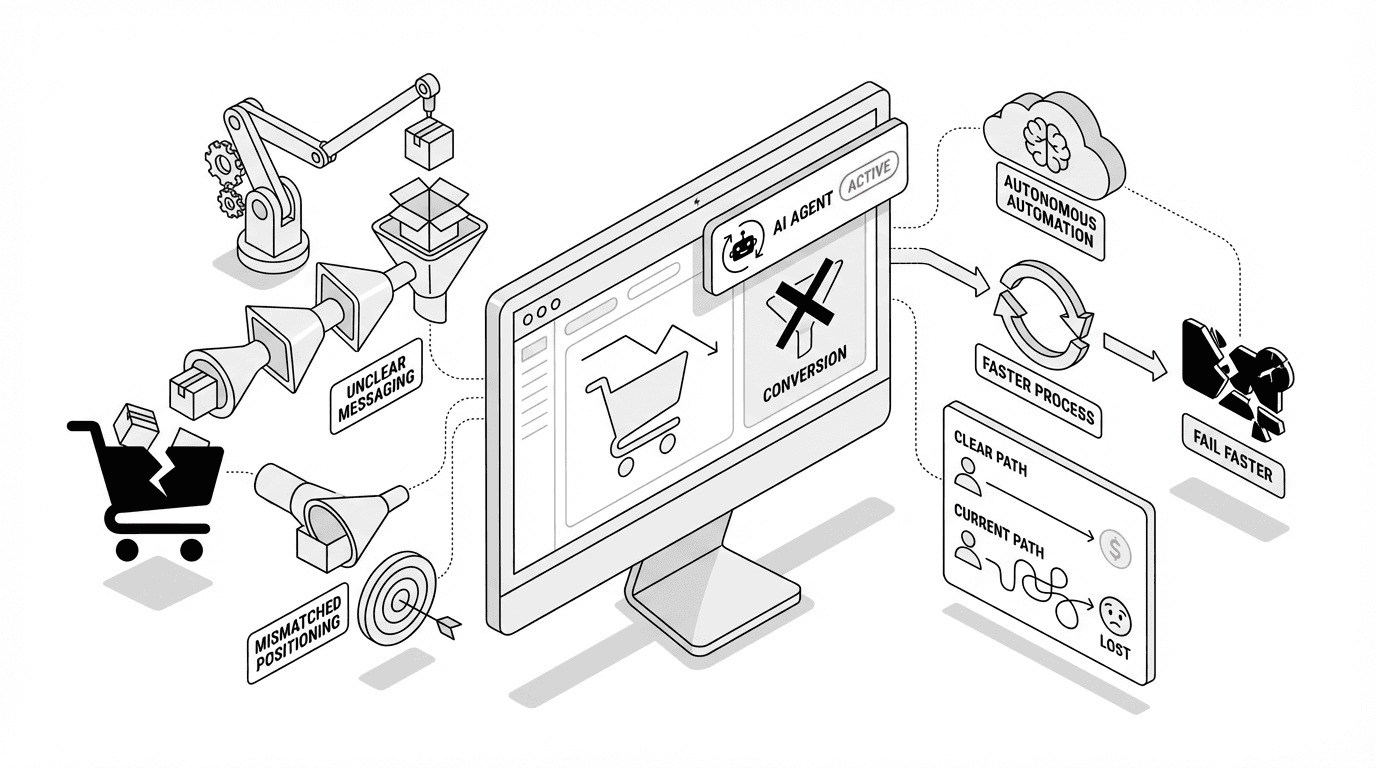
But an agent can't fix what you haven't defined. If your product positioning is unclear, if your ad message doesn't match your landing page, if your value proposition is buried below the fold, no autonomous action will solve that. The agent will optimize around the wrong variables because the foundation is broken.
Autonomy Means Speed, Not Diagnosis
Think of an autonomous agent as your own personal assistant. You give it a goal, like boosting your conversion rate,
The tradeoff: it can only work within the system you've built. If your product page doesn't explain why someone should buy, the agent can't rewrite your positioning. If your checkout has friction, the agent can't redesign it. It optimizes delivery, not clarity.
Most DTC stores doing $10K–$100K/month don't have an execution problem. They have a clarity problem. Traffic doesn't convert because visitors don't understand what you're selling, why it's different, or why they should care. An autonomous agent will just execute faster on top of that confusion.
What Agents Can and Can't Do
Agents excel at repetitive, data-driven tasks: monitoring inventory, adjusting bids, segmenting audiences, triggering abandoned cart flows. These matter, but they're downstream of the real problem.
They can't diagnose why your add-to-cart rate is 2% instead of 8%. They can't tell you that your hero image doesn't show the product in use. They can't identify that your ad promises a solution your landing page never mentions. They can't see that your headline is a feature dump instead of a benefit.
If you're struggling with conversion, adding autonomous agents before fixing structure and messaging is like hiring a project manager for a project with no plan.
Fix the Foundation First
Before you consider any autonomous system, audit the basics. Does your product page answer what this is, why someone should care, and why they should believe you? If not, no agent will save you.
Check ad-to-site consistency. If your ad talks about solving a specific pain point, does your landing page lead with that same pain point? Or does it open with a generic brand story? Agents can't bridge that gap.
Fix your visual hierarchy. Can someone scan your page in five seconds and understand what you're selling? If your most important information is competing with testimonials and trust badges, you're asking the visitor to do too much work.
Once those fundamentals are in place, autonomous tools become useful. They can scale what's already working. But if your store isn't converting now, automation just means failing faster.