
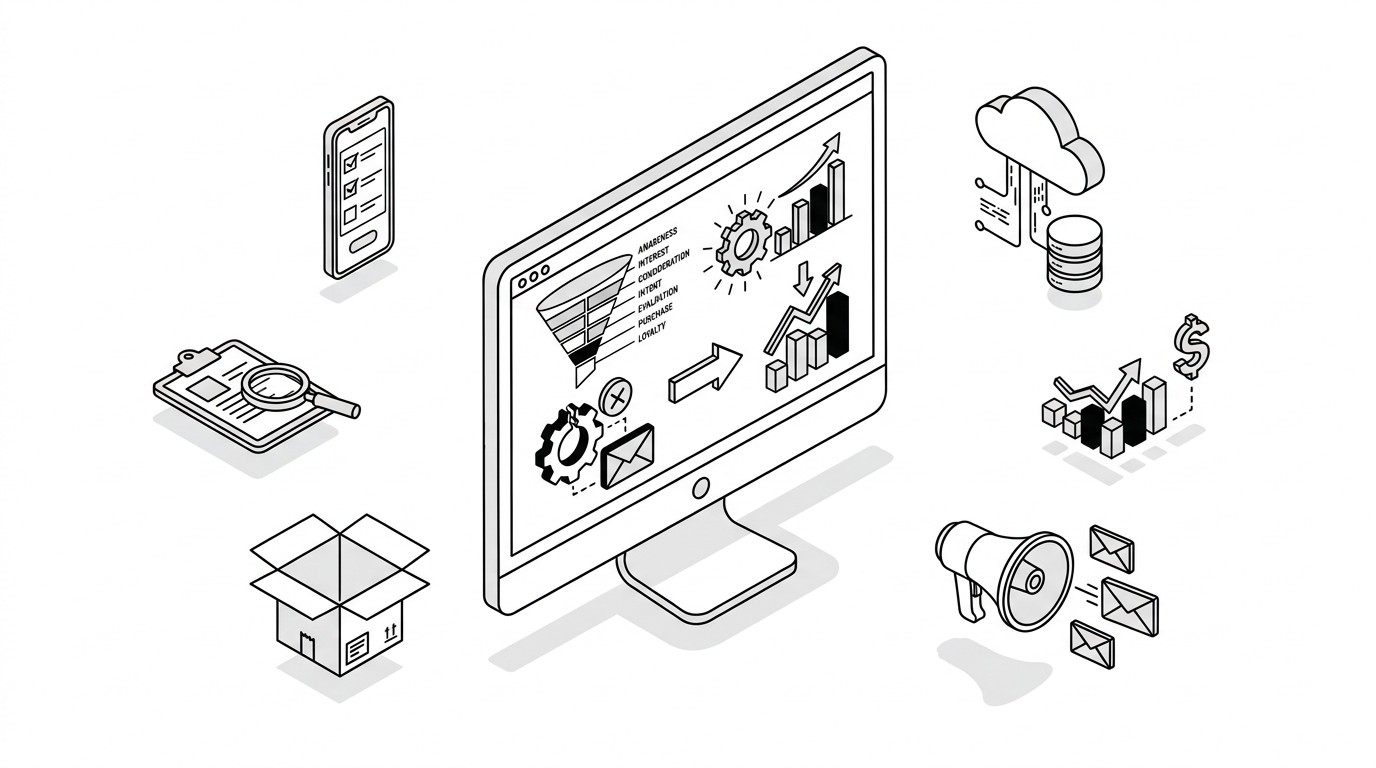
Shopify published seven email marketing objectives in April 2026. The list is sound. The problem is execution: most DTC stores treat these objectives as a checklist and try to build all seven at once. This splits attention across welcome sequences, cart abandonment flows, post-purchase emails, re-engagement campaigns, promotional blasts, educational content, and feedback requests. Each one gets built halfway. None of them get the focus needed to change your numbers.
If you're doing $10K–$100K/month, you likely have one or two specific conversion bottlenecks. The email objective that matters depends entirely on where your funnel is breaking. Treating all seven as equal priorities wastes time and budget.
Email Objectives Are a Diagnostic Tool, Not a Checklist
The Shopify article frames these seven objectives as a way to inform your strategy. That's accurate but incomplete. The operational reality is harder: if your add-to-cart rate is 8% but checkout completion sits at 35%, your priority is cart abandonment recovery. Educational content and customer feedback requests are noise until you fix that leak.
This matters because most founders pick objectives based on what sounds important or what competitors are doing. That's backward. Your email strategy should map to where visitors drop off. If paid traffic clicks through but bounces in 10 seconds, email won't help. You have an ad-to-site consistency problem. But if people add to cart and don't complete checkout, abandoned cart emails become your highest-return objective. If customers buy once and disappear, post-purchase sequences move to the top.
The tradeoff is real: focusing on one or two objectives means ignoring the others temporarily. That feels risky. But spreading effort across all seven means none of them work well enough to move revenue. Stores that grow from $50K to $150K/month do it by fixing the biggest leak first, then moving to the next one.
Why Copying Successful Brands Backfires
The Shopify article mentions learning from successful businesses. This is where most DTC founders waste months. A brand doing $2M/month can run all seven objectives simultaneously because they have the team, the data, and the margin to test everything. You don't. Copying their playbook means copying their resource allocation, and that doesn't scale down.
What works for a mature brand with high repeat purchase rates will fail for a store still figuring out product-market fit. The objectives might be the same, but the prioritization is completely different. If your average order value is $45 and your repeat purchase rate is under 10%, promotional emails won't save you. You need to fix product positioning and post-purchase experience first. Email can support that, but only if the objective aligns with the actual problem.
The scenario where all seven objectives matter equally is rare. It happens when your funnel is already optimized, conversion rates are healthy, and you're scaling through incremental improvements. If that's not you, treating this as a seven-part checklist will slow you down.
How to Pick the Right Objective
Start by identifying where your funnel breaks. Look at your analytics and find the stage with the biggest drop-off. Then pick the email objective that directly addresses that stage.
If it's traffic quality, email won't help. Fix your ad-to-site consistency. If it's cart abandonment, build one strong abandoned cart sequence before touching anything else. If it's repeat purchase rate, focus on post-purchase emails and re-engagement flows.
Once that objective is working, meaning it's measurably improving your conversion rate or revenue, move to the next one. This is slower than trying to build everything at once, but it's the only approach that compounds. Each objective you execute well makes the next one easier because you're working with a tighter funnel.
The seven email marketing objectives Shopify outlines are valid. They become a strategy only when you decide which one matters most for your store right now.