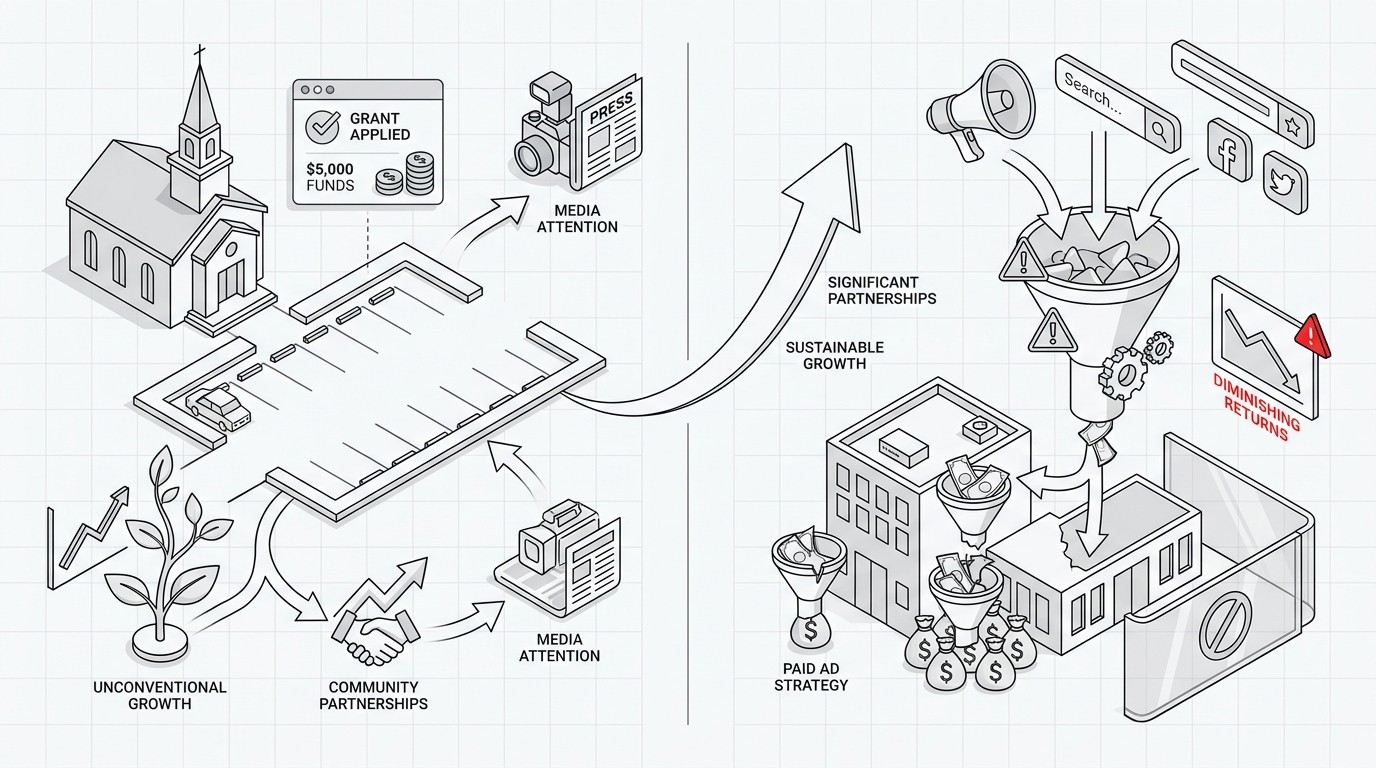
Carmen Dianne and Kara Still launched Prosperity Market during the pandemic with a $5,000 grant. No farming background. No trailer. They started with pop-ups in church parking lots across Los Angeles, bringing fresh food to Black communities. That operation now runs 80 vendors, earned a Good Morning America feature, and secured a partnership with Dr. Dre. Most Shopify brands burn $5,000 monthly on Facebook ads and get none of this.
The difference isn't budget. It's that Prosperity Market treated distribution as the product, not as a problem to solve after launch.
Distribution Validates Demand Before You Scale
Church parking lots weren't a placeholder until Dianne and Still could afford "real" marketing. The physical location was the entire strategy. A mobile farmers market in underserved LA neighborhoods signaled community trust and accessibility in ways a Shopify checkout page cannot. The distribution channel was inseparable from the value proposition: fresh food plus economic power for Black communities.
Most DTC brands invert this. They build a product, set up a store, then ask where to find customers. Prosperity Market started with the distribution channel and let it validate demand. If your paid ads aren't converting, the problem may not be creative or targeting. It may be that your distribution channel doesn't align with what you're actually selling. When those two things match, conversion friction drops.
Media Follows Narrative Clarity, Not PR Budgets
Good Morning America didn't feature Prosperity Market because of a publicist. They featured it because the story was sharp: two founders with no farming experience, a $5,000 grant, church parking lots, food access during a pandemic. That narrative has stakes and specificity. It's retellable.
Most DTC brands bury their story under product features or vague mission statements. "We make sustainable skincare" gives no one a reason to care. "We launched a mobile farmers market in church parking lots to bring economic power to underserved LA neighborhoods" does. The Dr. Dre partnership likely followed the same logic. High-profile partnerships don't come from cold outreach. They come from brands with a story worth associating with.
If a customer can't explain your brand's reason for existing in one sentence, neither can a journalist or partner. Prosperity Market's growth from pop-ups to 80 vendors created a credible scale story. The Good Morning America feature added media validation. Both made the brand partnership-ready without traditional lead generation.
Specificity Creates a Wedge, Not a Limit
Prosperity Market's story works because it's constrained. Mobile farmers market. Black communities. Los Angeles. Church parking lots. $5,000 grant. Remove any of these details and the narrative weakens.
Many DTC brands avoid this level of focus because they fear shrinking their addressable market. They want to appeal to everyone. But broad positioning makes paid ads expensive and conversion rates low. You're competing on product features alone, which means you're competing on price.
Prosperity Market could have positioned as "a farmers market for everyone." Instead, they focused on food access and economic power in Black communities. That specificity attracted media, partnerships, and customers who cared about that mission. It also made the brand memorable, which turns one-time buyers into repeat customers and word-of-mouth growth. Narrow narrative focus doesn't shrink your market. It creates a wedge.
Community Participation Compounds Differently Than Paid Traffic
Prosperity Market grew to 80 vendors. Each vendor brings their own customer base, their own story, their own reasons to promote the market. The brand became a platform, not just a retailer. This created a compounding advantage that paid ads can't replicate.
Most Shopify brands think of growth as customer acquisition. Prosperity Market built vendor acquisition into the model. Every new vendor expanded the product offering, the community reach, and the brand's credibility. The church parking lot pop-ups weren't just sales channels. They were community events. That's why the brand could grow from a $5,000 grant to national media and celebrity partnerships.
For DTC brands, the lesson isn't "become a marketplace." It's that growth models built on community participation scale differently than growth models built on paid traffic. If your brand can create value for participants beyond transactions, you build a moat that doesn't depend on your ad budget. The community becomes the distribution, the marketing, and the product validation.
What This Means for Your Store
If your paid ads aren't converting and your lead generation is stalling, the default response is to test new creative, adjust targeting, or hire a better media buyer. Those tactics matter, but they don't address the underlying issue: whether your brand has a distribution strategy and narrative that create organic momentum.
Prosperity Market's path from $5,000 to Dr. Dre wasn't luck. It was a clear mission, a distribution channel that reinforced that mission, and a narrative specific enough to attract media and partnerships. None of that required a large budget. It required strategic clarity.
Ask whether your brand's distribution channel aligns with your value proposition. Ask whether your narrative is specific enough to be retold. Ask whether your growth model creates community participation or just customer transactions. If the answers are unclear, no amount of ad spend will fix your conversion problem.